I head downstairs to my workspace. The third step creaks, then the seventh. By the time my feet meet concrete, the noise of the house above has faded, and something in my chest unclenches.
The smell hits me first: sawdust and linseed oil, the faint metallic tang of steel wool, something musty that might be old glue (or just old cellar). Sunlight angles through the casement window and catches every mote of dust suspended in the air, swirling like a slow galaxy.
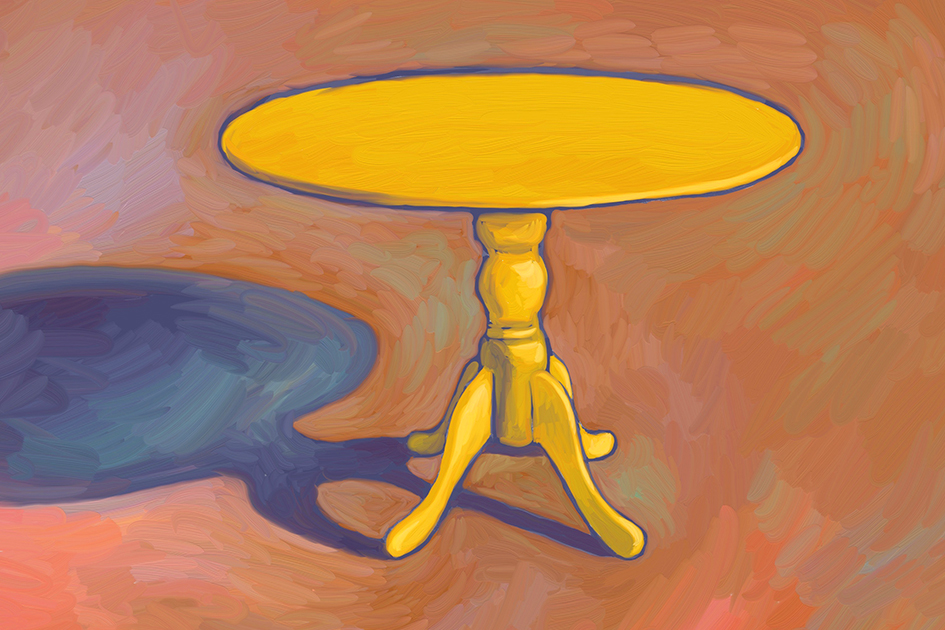 Illustration by Jeff Gregory
A drop-leaf table waits on my workbench, and I lay my hand on its surface in greeting. The wood is cool under my palm, decades of furniture polish and fingerprints creating a film that hides what’s underneath.
I trace the nicks and scratches. Most are shallow—the accumulated carelessness of ordinary use. But one mark stops me. It’s deep, maybe an inch long, wider at the top and narrowing as it cuts into the grain. I run my finger along the roughness where the wood split.
Do I fill this in? I ask myself. Sand it away? Let it remain?
Next, I test the table’s legs. There’s a wobble—the joints have loosened over time, pulled apart by years of weight. I crouch down and find hand-carved dovetails, the kind that take time and skill and attention. Someone made this piece with care. Someone looked at raw wood and saw what it could become—then spent hours coaxing it into being. That matters to me. I’m not just refinishing furniture. I’m honoring someone’s work, trying to let the craftsman’s artistry shine again.
I start by taking everything apart. Each screw drops into an old coffee can with a metallic plink. The legs come off and I stack them carefully. Then comes the part I always want to skip: scrubbing away the grime.
I fill a bucket with soapy water. The smell is clean and sharp. I dip the rag and start, watching brown water run down the grain, pooling in the joints. The water turns darker with each pass—decades of wax and oil lifting away.
It’s tedious. But I’ve learned you can’t skip steps in restoration. If you sand over dirt, you just grind it in more deeply. If you stain over grime, it seals the filth in forever.
Finally, I dump the murky water into the sink and turn on the fan to speed the drying. Its hum fills the space, mirroring the low thrum of worry that has been vibrating in my chest all morning. I lean against the workbench and breathe.
Lord, I’m anxious about money again. About time. About whether or not this even matters.
This workspace has become a place where I can whisper my worries aloud, trusting that the One who hears me is also the One who made the wood I’m touching, the craftsmen who first put it to use, the light streaming through the window.
Once the pieces are dry, I prepare for sanding. This part is loud and dusty and anything but glamorous. I start with coarse grit—rough enough to strip away the old finish. The orbital sander roars to life, vibrating up through my hands and into my arms. I flick on the shop vac and the noise doubles.
Dust blooms into the air, coating my forearms, settling in my hair. I can taste it—dry and slightly sweet, the ghost of old varnish mixing with raw wood. The surface looks worse now, not better. It’s raw and exposed.
The temptation rises sharp and urgent: Press harder, move faster, get this done. I glance at the clock. If I rush, I could have the table ready for sale by tomorrow and a little more money in my pocket. But I know better. Speed ruins everything in this work. Press too hard and you create divots that show up like bruises when stain is added. Rush and you miss spots or leave scratches that catch the light wrong.
I stop, set the sander down, and breathe. Help me be patient, God. Help me do this right.
When I let it move at its own pace, the sander is almost soothing. I guide it in overlapping circles, steady and methodical. And somewhere in the repetition—the noise, the dust, the endless back-and-forth—my thoughts settle. Transformation doesn’t happen in sweeping gestures. It happens here, in these small, deliberate movements.
I switch to finer grit, and the wood grows smoother under my hands. I can see the grain starting to emerge—subtle lines hidden under layers of wear. I wipe the dust away and angle the piece toward the light. The grain appears more clearly now, swirling in places, straight in others. Beautiful in the way of true things.
Another pass with even finer paper. The tabletop is almost glassy now, smooth enough that my hand glides without catching. But I don’t sand everything away. That deep gouge I noticed earlier—I leave it. The shallow groove near the corner—I leave that too. A faint indentation where someone’s arm rested, worn into the wood over decades—I run my finger over it and decide that it also needs to stay put.
I could fill them. But perfection feels wrong here, impersonal. These marks don’t weaken the table. They’re part of its story, evidence of a life lived. To erase them would be to pretend they never happened. The same is true of us as well. God doesn’t erase our scars when He restores us. He doesn’t sand us down to blank uniformity.
After His resurrection, Jesus appeared to Thomas along with the other disciples. “Reach here with your finger, and see My hands,” He told the doubting man, guiding him from scar to scar, “and reach here your hand and put it into My side; and do not be unbelieving, but believing” (John 20:27). Jesus’ wounds, healed but not erased, were not a source of shame. They told the story of His passion—of His great and unending love for the world.
Finally, I pull up a stool and sit. The shop is quiet now, the dust settled. As the late afternoon light slants through the window, turning everything golden, I think about the original craftsman again. I’ll never meet him, this man whose name I don’t know. He shaped this table decades ago with hand tools and patience, cutting dovetails that would hold, choosing wood that would last. And now I’m here, generations later, trying to let his work shine again.
It feels like partnership, somehow. Like I’m not working alone but joining something larger—a long line of people who believe that what’s broken can be mended, that what’s worn can be renewed, that careful attention is a form of love.
And underneath that, deeper still, I sense the presence of the One who invented restoration. The God who looks at damaged and worn-down things—like this table, like me—and sees what they were made to be. Who doesn’t discard what’s scarred but works with infinite patience to honor the original design, to transform without erasing.
I stand and stretch, feel my back protest, and decide that staining the table can wait until tomorrow. For now, it’s enough to have done this much—to have made something a little more itself than it was.
I flip off the light and head upstairs, the steps creaking in the familiar cadence I love so well. The smell of the shop clings to my clothes—wood and sweat and dust. Above me, I can hear life going on as it always does. But something has shifted. In the table and in me.