Can’t we just use paper plates?
My friend’s text message caught me off guard. I’d just finished sending her a detailed list of everything I had planned for the Easter dinner she and her husband would be attending at my home that evening. At first, her response offended me. I asked myself, Can’t she see I’m trying to create a lovely evening? Doesn’t she know paper plates aren’t exactly aesthetically pleasing?
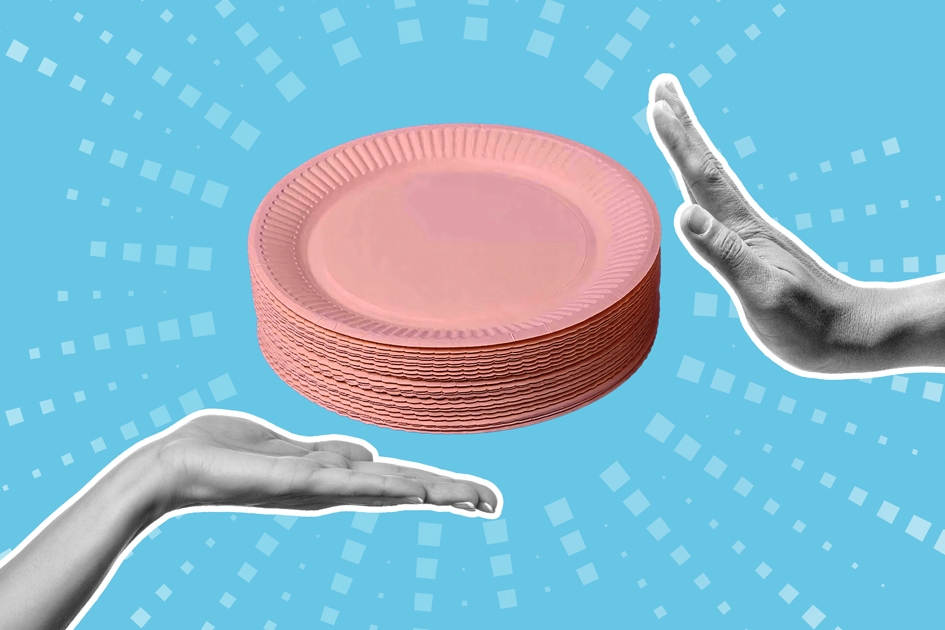 Illustration by Jeff Gregory
Perhaps my friend could sense what I could not: that my desire to control every detail of a gathering was actually controlling me. Looking back, I see she was offering me a profound gift—one that far outweighed the frantic (though well-intentioned) hospitality I’d planned. She was offering me the gift of simplicity, a deeply hospitable act for someone like me, who gets so caught up in the planning that she often forgets to savor the event itself.
We did not use paper plates that night, yet my friend’s question has stuck with me. I believe simplicity is something Jesus offers us, too—especially when it comes to our attempts to do things for God. However, in order to truly receive the gift of simplicity, we must sacrifice something. And that’s what makes it so challenging. Whether we sacrifice idealism, preferences, or resources, simplicity insists we lay these things down for the sake of receiving something better—namely, being with God and enjoying His good gifts.
Jesus doesn’t ask us about paper plates, of course. Rather, He asks something like, “Can you be with Me in prayerful silence and receive My love instead of working to earn My approval?” If you’re anything like me, this question might strike you as mildly off-putting. To be honest, I’d often rather “earn” God’s approval through good behavior than receive His unconditional love. Why? Because it makes me feel more in control.
The grace God offers is so extravagant that it can make us feel uncomfortable. This is reminiscent of the prodigal son, who, upon returning home, thought himself worthy only to be his father’s servant, not welcomed back into his family. Refusing to slow down and enjoy God’s presence, I tell Him, “No thanks. I’d prefer to work for You instead. At least then I know where I stand.”
In the Western world, busyness dogs our every step. Time, it seems, is never on our side, and rarely do we receive the satisfaction of checking everything off a to-do list. A sense of dissatisfaction with ourselves has become commonplace. Entire companies and advertising campaigns are designed to reinforce this feeling and to present themselves and their products as the solution to this unrelenting sense of dissatisfaction.
As the people of God, however, we are invited into a different way of being—one that calls us out of the fray and into the rhythms of simplicity. While our culture loves to tell us, “You’re not enough,” simplicity says, “God is enough.” And we can rest in that. It is a gentle truth and a much-needed corrective: Choosing contentment over anxious striving enables us to be gracious hosts who welcome others from a place of fulfillment in Christ.
The story in Luke 19:1-10 shows us what it looks like to receive the Lord’s gift of simplicity—and what it can create. Zaccheus, a wealthy tax collector, climbed into a tree to get a better view of Jesus. And what did Jesus do? He stopped at the base of that tree and invited Himself to Zaccheus’ house in an act of “reverse hospitality.” We’re told that the tax collector “hurried and came down and received Him gladly” (v. 6).
This verse does not tell us that Zaccheus rushed home to clean his house or prepare an extravagant feast. Instead, he welcomed Jesus happily and immediately—choosing to embrace the gift of Jesus’ presence without of striving for perfectionism to make himself “worthy” of the Lord’s loving presence. After the meal he shared with the Savior, Zaccheus pledged to give half of his possessions to the poor and to right the wrongs he had caused. Jesus had invited Zaccheus into simplicity by saying, I’m coming to your house today, and that experience sparked genuine and vibrant generosity. Because he received the simple yet profound gift of being seen and chosen by Jesus, Zaccheus could see and choose others over himself.
I wonder if the same might be true for us. Embracing a “paper plate mindset” lowers the threshold of joining one another around God’s table and allows us to enjoy grace and contentment in a richer, more fulfilling way. If we’re too busy to identify and enjoy God’s gifts with one another, perhaps we are not living simply enough. But by paring away what is unnecessary, we create spaces for joy, gratitude, and generosity to fully flourish.
As one who often believes the lie that if I am not busy, I am not doing enough (or even more insidiously—I am not enough) I understand how hard it is to switch from an “earning mentality” to a receiving one when approaching both God and my to-do list. Practicing simplicity, however, teaches me that God is the arbiter of what “enough” looks like. I do not need to strive for more than what He has already given me to pursue (Eph. 2:10).
Scripture tells me the one thing I truly need to do each day is to love God and love others as myself (Matt. 22:37-39). This whittles my to-do list down to a single item: How am I called to love today? Asking this question each morning serves to re-orient me toward seeking God’s kingdom first, above the ever-elusive promise that overachieving will lead to something “greater” than what God freely gives.