We humans are forgetful creatures by nature. Our attention drifts after only a few moments, memories begin to fade almost as soon as they’re created, and promises made in good times are often forgotten when life gets difficult. Maybe that’s why the hymn “Come, Thou Fount of Every Blessing” has always resonated so deeply with me: “Prone to wander, Lord, I feel it, prone to leave the God I love.”
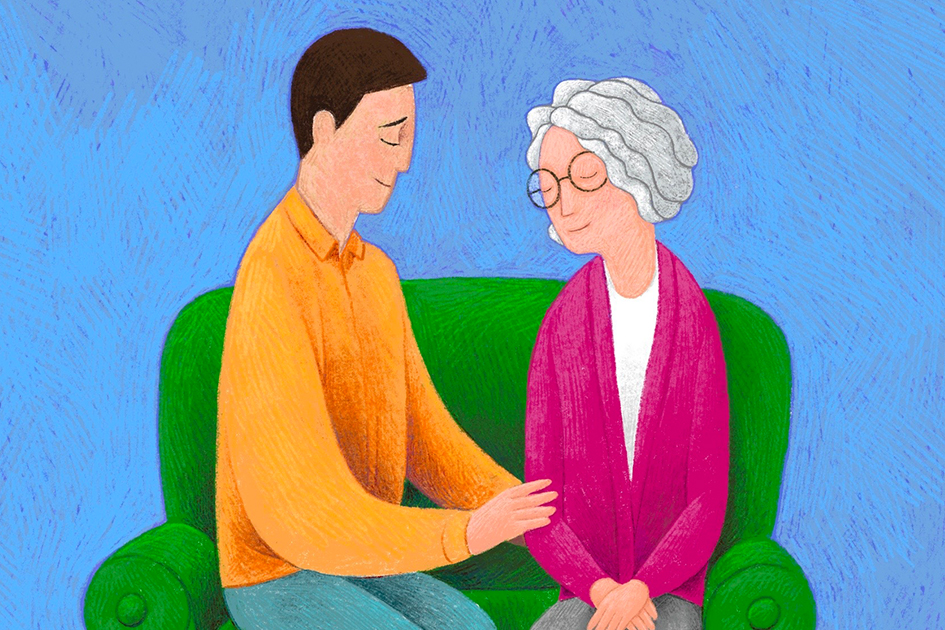 Illustration by Jeff Gregory
In the past couple of years, I’ve had cause to reflect on what God’s perspective might be in those moments when His children stray. As I’ve watched my grandmother progress through dementia, I have discovered what it is to be forgotten, and that experience has deepened my appreciation for the Lord’s steadfastness.
Dementia is a terribly sly disease. You lose your loved one slowly and then seemingly all at once. With my grandmother, it started with her struggle to find words in conversation. It progressed to her being slow to recognize us. And then one day, she didn’t recognize us at all. That was the moment I realized that I’d already had my last day with her.
Every visit from then on, she would ask us where we were from. She remembered she had a grandson who lived in Louisville with his wife and two of her great-grandsons, so we would tell her, “Yes, Mamaw, that's us.” She'd be surprised and happy, but you could tell she was doubtful—not quite able to make the connection between the facts and the people sitting across from her.
Perhaps you’ve had a similar experience involving your faith. When life gets hard—because of relationship difficulties, trouble at work, uncertainty about finances, or any number of other things—it's easy to slip into a funk. You're still reasonably confident there is a God somewhere, but you don't recognize Him when He's right in front of you. Thankfully, no matter how many times you lose sight of Him, He promises, “I will not forget you. Behold, I have inscribed you on the palms of My hands” (Isa. 49:15-16).
As her dementia progressed, my grandmother went from forgetting familiar faces to not recognizing she was in her own home of more than 60 years. She would tell us her parents (both deceased in the 1990s) would be there soon to pick her up and take her to a home she hadn’t lived in since the 1950s. For a while, various family members would try to gently remind her where she was and that her parents had gone on to be with the Lord some time ago. The hope was that it would keep her from being upset waiting on something that was never going to happen. But it actually did more harm than good.
That was a pivotal season, when each of us in the family had to come to terms with the truth and carry out sacrificial love. Of course, there were the practical sacrifices of caring for someone who increasingly could not safely manage any daily tasks. But there was also the sacrifice of letting go of the hope that things would get back to normal.
One of my sweetest memories with her came near the end. We were at my parents’ house for a holiday, and she began asking about when her dad would arrive. Our plan was to have a meal before my dad drove her home, but the food wasn’t ready. So I sat down on the couch next to her and started asking questions about her childhood in Athens, Kentucky. I was surprised how readily she answered them. I used every scrap of information I could remember to keep the conversation going, and while it didn’t ultimately amount to much more than small talk, for a while I was with my grandmother again.
In that conversation, I think I learned something about how God endures with me when my heart wanders. I forget Him, so He does the remembering for me. I could enter into my grandmother's past only superficially, but God entered mine fully and refuses to let go. He continually and patiently calls me back, no matter how far away I drift.
My grandmother passed away in September of 2025. In her obituary, it says, “We miss her already but rejoice knowing that we’ll meet her again and she is now with the Lord, fully restored to joy in His presence.” The slow loss of her mind was only temporary, never to be repeated. Thankfully, I was able to spend a few extra minutes with her by talking about the past. But through Christ, God has prepared a reunion where no one forgets and no one is forgotten, where we are fully known—not just for a moment, but forever.
Caring for a Loved One With Dementia
There are good resources available for the practical side of caring for a family member with dementia, and it’s very important to talk to their doctor how to best care for them and their specific progression. That said, here are a few things I gained through experience:
Give yourself grace. You are grieving the loss of someone who is still alive. That’s hard. You won’t handle everything perfectly.
Know that long-term memory can be quite resilient. The person you love might not be in the present moment with you much (if at all), but much of his or her history is likely still there to connect with.
Adopt a posture of curiosity. Loved ones with dementia may not recognize where they are or ask about family members long passed. It’s important not to correct them. You cannot give them back lost memories or bring them into the present. Instead, ask questions. If they are talking about a past season or a lost relative, try to enter their memories with them. Ask them about their parents or about their hometown or elementary school. You might get the unexpected blessing of learning things about their past (and yours).